The carbon dioxide concentration of the atmosphere is projected to increase by almost 50% over the first 50 years of this century (IPCC 2001). The major cause of this case is continued combustion of fossil fuels. Thus, resulting in the increased of global temperature. The increase of climate can cause damage to global ecosystems, food production and give rise to many economic issues. The use of bio-resource products as a source of energy can overcome this matter and provides long-term solution. In the European Union (EU) countries, which are all signatories, will meet part of this commitment to reduce net carbon dioxide emissions to the atmosphere by increasing the proportion of electricity that they generate from renewable resources. Unlike wind or other energy sources which depends on weather, biomass represents stored energy that may be drawn upon on demand. Hence, the biomass represents can be used any time and with endless supply.

Bioenergy
Useful, renewable energy produced from organic matter. The conversion of the complex carbohydrates in organic matter to energy. Organic matter may either be used directly as a fuel or processed into liquids and gases.

EXAMPLES OF BIORESOURCES THAT CAN BE CONVERTED INTO ENERGY
- Urban wood waste.
Urban wood waste generally consists of lawn and tree trimmings, whole tree trunks, wood pallets and any other construction and demolition wastes made from lumber. This rejected material can easily be collected after a construction or demolition project and turned into mulch, compost or used to fuel bioenergy plants.
- Municipal Solid Waste.
Residential, commercial, and institutional post-consumer wastes contain a significant proportion of plant derived organic material that constitutes a renewable energy resource. Waste paper, cardboard, wood waste and yard wastes are examples of biomass resources in municipal wastes.
 |
| Municipal wastes |
- Energy crops
Energy crops are bioengineered to be fast-growing plants, trees or other herbaceous biomass which are harvested specifically for energy production use. These crops can be grown, cut and replaced quickly. Herbaceous energy crops are perennials that are harvested annually after taking two to three years to reach full productivity. These include grasses such as switchgrass, Miscanthus (Elephant grass), bamboo, sweet sorghum, tall fescue, kochia, wheatgrass, and others. These crops are generally grown for fuel production.
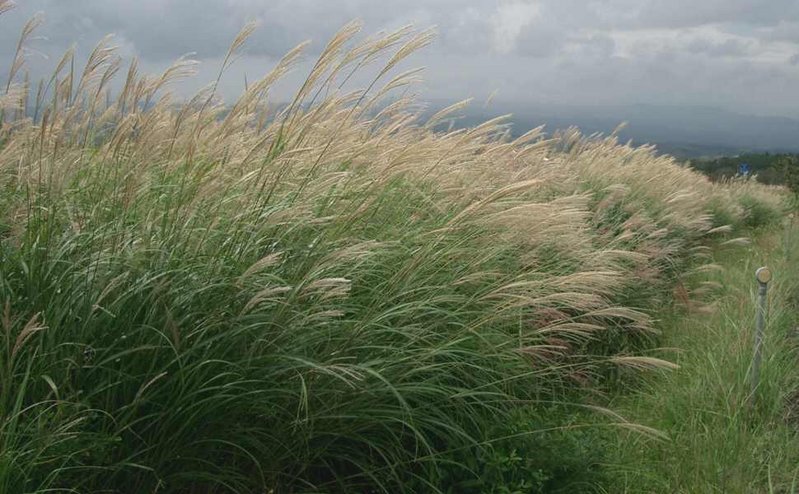 |
| Miscanthus sinensis |
- Woody Energy Crops
Short-rotation woody crops are fast growing hardwood trees harvested within five to eight years after planting. These include hybrid poplar, hybrid willow, silver maple, eastern cottonwood, green ash, black walnut, sweetgum, and sycamore.
 |
| Silver Maple (Acer saccharinum) |
- Industrial Crops
Industrial crops are being developed and grown to produce specific industrial chemicals or materials. Examples include kenaf and straws for fiber, and castor for ricinoleic acid. New transgenic crops are being developed that produce the desired chemicals as part of the plant composition, requiring only extraction and purification of the product.
 |
| Molecular Structure of a Ricinoleic Acid |
- Agricultural Crops
These feedstocks include the currently available commodity products such as cornstarch and corn oil, soybean oil and meal, wheat starch, other vegetable oils and any newly developed component of future commodity crops. They generally yield sugars, oils, and extractives, although they can also be used to produce plastics and other chemicals and products.

Direct-Fired or Conventional Steam Boiler.
Most of the bio-power plants in the world use a direct-fired system or a conventional steam boiler. Both systems burn bioenergy feedstock directly to produce steam which in turn creates electricity. Differences in the methods lie within the boiler or furnace structure. In a direct-fired system, biomass is loaded in from the bottom of the boiler and air is supplied at the base. In a conventional steam boiler, the draft is forced in through the top but the biomass is also bottom loaded. Traditional direct-fired systems are the pile system (which uses a two-chamber combustion chamber) or the stoker boiler. Hot combustion gases are passed through a heat exchanger in which water is boiled to create steam. This steam is usually captured by a turbine, causing the turbine blades to rotate. The rotation is attached to an electrical generator, which then creates electricity.

METHODS TO GENERATE ELECTRICITY BY BIORESOURCES CONSUMPTION
Most of the bio-power plants in the world use a direct-fired system or a conventional steam boiler. Both systems burn bioenergy feedstock directly to produce steam which in turn creates electricity. Differences in the methods lie within the boiler or furnace structure. In a direct-fired system, biomass is loaded in from the bottom of the boiler and air is supplied at the base. In a conventional steam boiler, the draft is forced in through the top but the biomass is also bottom loaded. Traditional direct-fired systems are the pile system (which uses a two-chamber combustion chamber) or the stoker boiler. Hot combustion gases are passed through a heat exchanger in which water is boiled to create steam. This steam is usually captured by a turbine, causing the turbine blades to rotate. The rotation is attached to an electrical generator, which then creates electricity.

When biomass is directly-fired, or burned it must first be dried, as dry wood burns more efficiently, sized into smaller pieces, and then briquetted. Briquetting is a densification process of loose organic material, such as rice husk, sawdust and coffee husk, aiming to improve handling and combustion characteristics. Briquetting can be done in a number of ways, with or without binders or with bio-coal technology. Once preparation is complete, the biomass is added to a furnace or a boiler to generate heat which is then run through a turbine which drives an electrical generator. The heat generated by the exothermic process of combustion to power the generator can also be used to regulate temperature of the plant and other buildings, making the whole process much more efficient. A plant using this type of technology is called a combined heat and power (CHP) facility and as its name suggests, it uses both the heat and the steam, so that there is less potential energy wasted. For instance, wood waste is often used to produce both electricity and steam at paper mills. If CHP is needed then the steam is condensed at a higher pressure in the water heater.
Co-firing.Co-firing, combining biomass with coal to generate energy, is probably the most compatible way to use biomass with the current fossil fuel dependent system. With co-firing, woody and herbaceous biomass such as poplar, willow and switchgrass can fuel a small portion of an existing coal power plant. This process entails biomass that represents between 1% and 15% of the energy of the coal plant, with the remainder consisting of coal. In these systems, biomass is placed into the boilers and burned, as coal would be. Often the only cost associated with upgrading the system to burn both fuels is to purchase a boiler capable of doing so, and retrofitting it into the system, which is a whole lot cheaper than building a whole other plant. According to the National Renewable Energy Laboratory (NREL) Biopower Fact Sheet, co-firing has been "demonstrated, tested, and proved in all little boiler types commonly used by electric companies with little or no loss in total boiler efficiency." In fact efficiency may even be increased by 33%-37%. Using biomass with coal helps to bring down the highly damaging emissions which are given off by the coal plants. Large scale coal-powered boilers currently represent 310 GW of power in the United States (enough to power 14,000,000 homes). There are several environmental benefits of adding biomass to coal, including decreases in nitrogen and sulphur oxides, the causes of smog, acid rain and ozone pollution. Also, the amount of carbon dioxide released is also considerably less.
Pyrolysis.
Pyrolysis is a process where biomass is combusted at high temperatures and decomposed in the absence of oxygen. However, some difficulties arises when trying to create a totally oxygen free atmosphere. Often a little oxidation does occur which may create undesirable byproducts and also it is highly energy intensive and expensive at the moment. The burning creates pyrolysis oil, char or syngas which can then be used like petroleum to generate electricity. It does not create ash or energy directly. Instead it morphs the biomass into higher quality fuel. The process begins with a drying process in order to maximize burning potential from the biomass, similar to the direct combustion process above. When cooled, the brown liquidy pyrolysis oil can be used in a gasifier.
 |
| Pyrolysis Process Flow Diagram |
When sped up, a process known as Fast Pyrolysis, up to 75% more bio-oil or pyrolysis oil is generated. In fact, the European Biomass Technology Group has created bio-oil using the fast pyrolysis technique by combining wood residue with hot sand in a rotating cone. In a small scale experimental setting, the rotating pyrolysis cone technology uses 250 tons of wood/day and generates 50 tons of oil (the equivalent of .314 barrels of oil). Experimenters suggest that the cone can be modified to take on larger loads and if done, bio-oil is already at a competitive price on the market. Some have suggested that pyrolysis even be used to generate hydrogen for use in fuel cells.
Biomass gasification
Solid biomass can be converted into a gaseous form, known as syngas. The gas can then run through “combined-cycle” gas turbine or another power conversion technology such as a coal power plant. Many experts hope that gasification can yield more efficient biomass power plants. At this stage, gasification is still in the “demonstration” phase as projects slowly come online. Biomass gasifiers operate by heating biomass in an environment where the solid biomass breaks down to form a flammable gas. This offers advantages over directly burning the biomass. The biogas can be cleaned and filtered to remove problem chemical compounds. The gas can be used in more efficient power generation systems called combined-cycles, which combine gas turbines and steam turbines to produce electricity. The efficiency of these systems can reach 60%. First the fuel is placed into the gasifier, where it is turned into a hot pressurized combustion gas. Then it is fed through a gas cleaner to precipitate out elements that would corrode the system. These elements vary depending on the source burned. The cleaned gases are then combusted and used to spin a turbine, which generates electricity. Heat released from the gas in the turbine can be recovered using water in the heat exchanger. The hot water can be recycled through the system. The only other by-product is non-toxic ash, which could, for example, be mixed with compost to help grow more biomass fuel. Gasification systems are also being developed for the fuel cell sector for future applications. Fuel cells convert hydrogen gas to electricity (and heat) using an electro-chemical process. There are very little air emissions and the primary exhaust is water vapor. "As the costs of fuel cells and biomass gasifiers come down, these systems will proliferate," reports the Energy Efficiency and Renewable Energy Office.
---------------------------------------------------------------------------------------------------------------------
Bioresource products can be a vital alternative source of energy because the sources are renewable. Using bioenergy can sustain atmospheric temperature and also prevent pollutions. There are many sources of bioenergy such as urban waste, municipal solid waste, energy crops, woody energy crops, industrial crops, and agricultural crops. The methods to process biomass represents to generate energy are also easy to be controlled, relatively economic, convenient and environmental friendly. The use of bioresources as source of energy can ensure a healthier environment for the future besides providing a renewable energy supply.
